
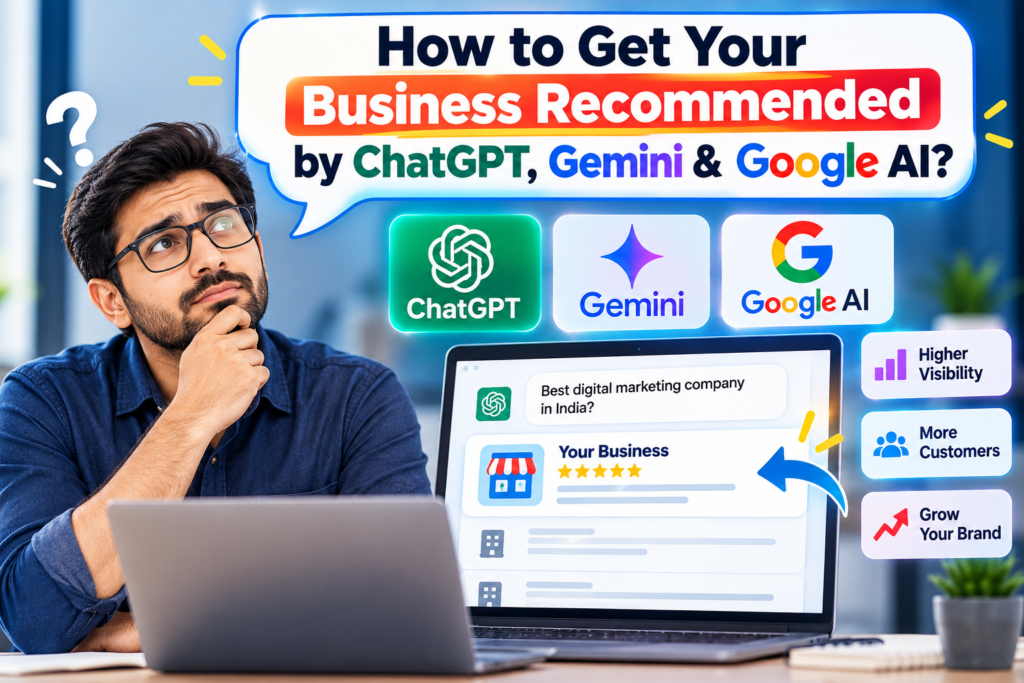
A few years ago, a customer searching for “best accounting software for small businesses” would scan ten blue links. Today, they often type the question into ChatGPT, ask Gemini, or read the AI Overview at the top of Google, and act on the answer they get.
If your business isn’t part of that answer, you are invisible to a growing share of buyers.
The good news is that AI search visibility can be built deliberately. This guide explains how AI search engines choose which businesses to recommend and gives you a practical AI search optimisation strategy you can start using today.
How AI Search Is Changing Customer Behaviour
Traditional search returns a list of links and leaves the decision to the user. AI search does something different: it reads many sources, summarises them, and often names specific brands or sources.
This changes three things:
- Queries are longer and more conversational. People ask full questions like “Which SEO agency is good for a manufacturing business in Delhi NCR?”
- Fewer clicks happen on the results page. Users may get what they need from the AI answer itself.
- Trust is concentrated. AI tools tend to cite a small set of sources, so being included matters far more than ranking tenth.
That is why AI search optimisation has become a separate priority alongside traditional SEO.
How ChatGPT, Gemini, and Google AI Decide What to Recommend
Each platform works differently, and their methods change often. But a few principles hold across all of them.
1. They rely on content they can find and understand. Whether through web search features, live retrieval, or their search index, AI tools draw on accessible, well-structured web pages. If your content is hard to crawl or unclear, it is less likely to be used.
2. They favour credible, consistent sources. Brands with clear expertise, trustworthy backlinks, reviews, and consistent information across the web look safer to cite.
3. They match the question directly. Content that answers a specific question clearly and early is easier for AI to extract and quote.
4. They learn from the wider web. Mentions on third-party sites, directories, forums, news, and review platforms help AI systems form an understanding of who you are and what you do.
No one can guarantee a recommendation from ChatGPT or Gemini, and anyone who does is overpromising. What you can do is improve the odds, and that is what Generative Engine Optimisation (GEO) is about.
What Is Generative Engine Optimisation (GEO)?
GEO is the practice of optimising your content, website, and brand presence so generative AI tools can understand, trust, and cite you. It builds on SEO fundamentals but adds a focus on:
- Clear, extractable answers
- Entity and brand consistency
- Structured data
- Authority and third-party validation
Think of it this way: SEO helps you rank. GEO helps you get named. A strong AI SEO for businesses programme does both.
9 Steps to Get Recommended by ChatGPT, Gemini & Google AI
1. Build a rock-solid SEO foundation
Everything starts here. Make sure your site is fast, mobile-friendly, secure, and easy to crawl. Fix broken links, duplicate content, and indexing problems. Pages that don’t perform well in Google rarely get picked up by AI features such as Google AI Overviews.
2. Write answer-first content
AI tools favour content that gets to the point. For every key page or blog:
- Put a direct, concise answer in the first few lines
- Follow with deeper explanation, examples, and context
- Use clear headings phrased like real questions
- Add short FAQ sections covering follow-up queries
This format helps both readers and machines, and it is central to how to get cited by ChatGPT.
3. Target conversational, long-tail queries
Move beyond short keywords. Build content around the questions your customers actually ask, such as:
- “What is the best CRM for a 20-person sales team in India?”
- “How much does a website redesign cost for a small business?”
- “Which company offers AI SEO services near me?”
Customer calls, sales emails, and Google’s People Also Ask boxes are goldmines for these.
4. Use structured data (schema markup)
Schema helps machines understand what your content means. At minimum, consider:
- Organization and LocalBusiness schema
- Service and Product schema
- FAQPage and Article schema
- Review and Author markup where appropriate
Structured data won’t guarantee a mention, but it removes ambiguity, which AI systems value.
5. Strengthen your brand entity
AI tools need to be confident about who you are. Keep your business name, address, services, description, and contact details identical across:
- Your website and About page
- Google Business Profile
- LinkedIn, X, YouTube, and other social profiles
- Industry directories and listings
Add a clear “What we do / Who we serve” statement on your homepage. This helps with Gemini SEO, where Google’s understanding of your brand entity matters a great deal.
6. Demonstrate real expertise (E-E-A-T)
Experience, expertise, authoritativeness, and trust remain central. Show them by:
- Publishing author bios with real credentials
- Sharing original insights, case studies, and data
- Showing client results and testimonials (with permission)
- Citing reputable sources for claims
- Keeping content updated
Generic content that could have been written by anyone is exactly what AI summaries make redundant. Original perspective is what earns citations.
7. Earn mentions and links beyond your own site
AI systems learn from what others say about you. Build authority by:
- Getting featured in industry publications and blogs
- Contributing expert comments and guest articles
- Collecting genuine reviews on Google and relevant platforms
- Participating in credible communities and Q&A forums
- Pursuing partnerships, awards, and speaking opportunities
This off-site presence is a major part of how to rank in ChatGPT style answers, because it validates you as a real, trusted business.
8. Create content formats AI can easily use
Make your pages easy to quote:
- Short definitions and summaries
- Comparison tables and checklists
- Step-by-step guides
- Pricing or “how it works” explanations
- Original statistics or surveys
Structured, scannable content is simpler for AI to extract than long, unbroken text.
9. Track, test, and adapt
AI search is new and changing. Build a simple monitoring routine:
- Regularly ask ChatGPT, Gemini, Perplexity, and Google your target questions
- Note whether your brand is mentioned, and which competitors appear
- Track referral traffic from AI platforms in analytics
- Monitor branded search growth
- Update content based on what gets picked up
Treat it as ongoing measurement rather than a one-time fix.
Google AI Overviews SEO: What to Focus On
For Google AI SEO, these priorities matter most:
- Rank well in standard search. AI Overviews generally draw from pages that already perform well.
- Answer the query completely. Cover the main question and related sub-questions in one resource.
- Use clear structure. Headings, lists, and tables help Google extract information.
- Keep content helpful and original. Thin or copied content rarely gets featured.
- Support with visuals and video where relevant, since Google increasingly blends formats.
- Maintain strong technical health with fast loading, mobile usability, and clean indexing.
Common Mistakes That Hurt AI Search Visibility
- Publishing mass-produced AI content with no human expertise
- Hiding key information behind scripts, pop-ups, or poor site structure
- Having inconsistent business information across platforms
- Ignoring reviews and reputation
- Writing only for keywords instead of real questions
- Blocking AI crawlers without understanding the trade-offs
- Expecting overnight results
A Simple 30-Day Starter Plan
Week 1: Audit your site’s technical health and test 10 to 15 customer questions across ChatGPT, Gemini, and Google. Record the results.
Week 2: Fix technical issues, add schema, and clean up your business information across all profiles.
Week 3: Rewrite or create your top service pages and FAQs in answer-first format.
Week 4: Start an authority-building push through reviews, outreach, and partnerships, then set up monthly monitoring.
Why Work With an AI SEO Partner
Doing all this well takes technical know-how, content skill, and consistent effort. An experienced team can audit where you stand, find the gaps, and build a plan around your industry and goals.
At Absolute Web Promotions, we help businesses improve their visibility across Google and AI search platforms with a strategy that combines proven SEO with AI-powered search optimisation and GEO.
[Add your real proof here: results, client types, or a short case study.]
Frequently Asked Questions
Can I pay to get recommended by ChatGPT?
No. Recommendations are not sold as ads in the way search ads are. Visibility comes from having credible, accessible, well-structured content and a strong online reputation.
Is ChatGPT SEO different from regular SEO?
It builds on regular SEO but puts more weight on clear answers, brand entity strength, and third-party mentions.
How long does it take to see results?
Expect gradual progress over a few months. Technical and content improvements can show early signals, while authority takes longer.
Do small businesses have a chance?
Yes. AI tools often favour specific, helpful, locally relevant content, which gives focused small businesses a real opening.
Will AI search replace Google?
Not entirely. The two are converging, and the smart move is to optimise for both.
Get Your Business Recommended by AI
Your customers are already asking AI tools who to trust. The businesses that act now will be the ones those tools learn to recommend.
Talk to Absolute Web Promotions for a free AI search visibility audit. We’ll check how your brand appears in ChatGPT, Gemini, and Google AI, show you the gaps, and map out your next steps.